Trawler Buying Guide: Great Loop & Liveaboard Tips
Trawler buying guide: displacement vs semi-displacement hulls, Great Loop specs, liveaboard layouts, prices and used-boat checks.
9 min readBoat Buying Guides
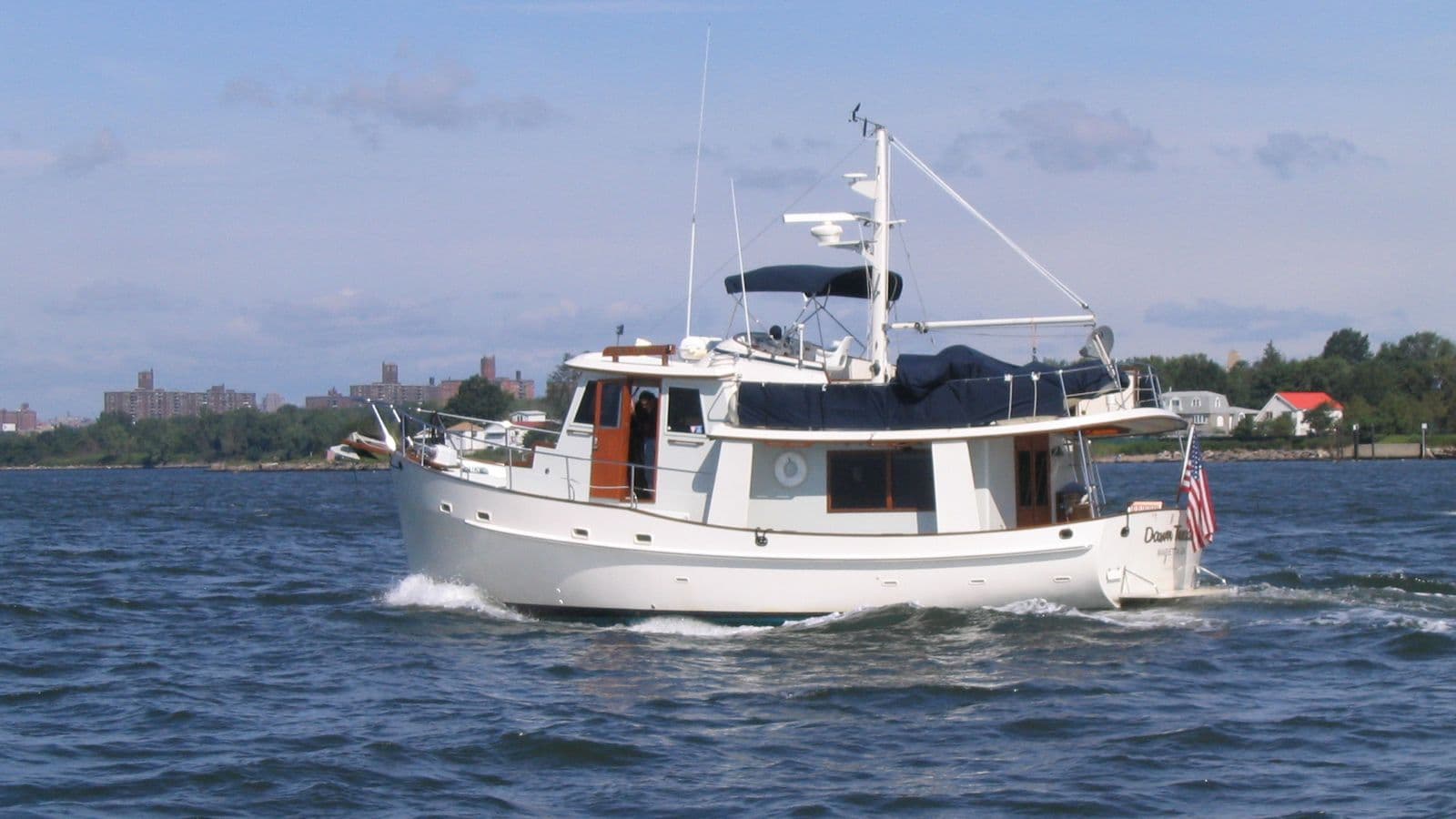
Every other boat type is bought for what it does on a Saturday; a trawler is bought for where it takes you over a season. That is why this trawler buying guide starts with the journey, not the boat. Its readers are Great Loopers speccing a boat to a 6,000-mile route and liveaboard buyers speccing one to a life afloat; both need range, volume and durable systems. The boat buying guide covers the general purchase process; this guide owns the trawler decisions: hull, layout, Loop dimensions, engines, prices, checks.
What Is a Trawler — and Who It's For
A trawler is a power cruiser built around range, living space and low-speed economy. The type descends from working fishing vessels — high bow, protected propeller, diesel power — and the recreational version trades the fish hold for staterooms. Most measure 34 to 55 feet and are designed to be run by a couple without crew.
That brief suits two buyers: the long-distance cruiser, who measures a boat in miles per tank and nights at anchor, and the liveaboard, whose boat is a home that occasionally moves. If your plan is measured in months aboard, almost nothing else is built for it.
Displacement vs Semi-Displacement vs Planing "Fast Trawlers"
"Trawler" covers three hull forms that behave like three different boat types, and choosing between them is the first real decision in any trawler buying guide.
Full displacement: the mileage hull
A full-displacement hull pushes water aside rather than climbing over it, so it is capped at hull speed — about 8.5 knots on a 40-foot waterline — and efficient below it. Kadey-Krogen built only this form before its 2026 Chapter 7 closure: its 44 AE runs a single 158 hp John Deere diesel, cruises at 7 to 8 knots, tops out at 9, and carries 850 gallons for a manufacturer-rated 4,450 nautical miles at 6 knots. Nothing else touches that economy; nothing else is that slow.
Semi-displacement: the compromise hull
Semi-displacement hulls add flatter aft sections, letting the boat climb partway onto the water. The classic Grand Banks Heritage form cruises around 14 knots and reaches 16 to 21 knots depending on engines, at several times a displacement boat's fuel burn.
Planing fast trawlers: the speed end
Fast trawlers keep the trawler layout — raised helm, protected decks, cruising interior — on a true planing hull. Grand Banks' current GB54 is the marker: twin 725 hp diesels, a 26-knot cruise, 29 knots flat out, 925 gallons and a published 490-nautical-mile range at 21 knots. Range is the trade; 150-mile days are the reward.
Trawler Sizes and Layouts: Flybridge, Pilothouse and Sedan
Three profile families cover the segment. Flybridge boats add a second helm on top — the classic Grand Banks silhouette — gaining visibility at the cost of air draft — a hard constraint if the Loop is in your plans. Pilothouse boats raise the helm inside a wheelhouse with near-360-degree views and side-deck access; it is the passagemaker's layout. Sedan boats keep a lower profile and easier bridge clearance.
Galley up or galley down
Galley-up puts the kitchen on the main deck beside the saloon — light, social, the cook in the conversation. Galley-down moves it below, freeing the main deck for seating or a larger guest cabin. Liveaboards who cook daily tend to choose galley-up.
The liveaboard checklist
Judge any layout against a month aboard: a stall shower separate from the head, a galley that cooks real meals, washer/dryer space, workable engine access, closet-grade storage. Two staterooms is the couple-plus-guests standard.
Buying a Trawler for the Great Loop
The Great Loop is a roughly 6,000-mile circuit of the eastern United States and Canada — East Coast, New York canals, Great Lakes and inland rivers. The America's Great Loop Cruisers' Association publishes the constraints that size a Loop boat — hard numbers, not preferences.
Air draft is the gate. The lowest unavoidable fixed bridge on the route is charted at 19.6 feet, at mile 300.6 on the Illinois River, and there is no way around it: the highest fixed point must clear it or fold below it. Kadey-Krogen listings made the point: one Krogen 44's arch hinges down from 20 feet for this reason, and a Krogen 48 carries a 19-foot air draft with mast and antennas up. Clearing 15 feet opens the Erie Canal's western end; 17 feet opens the Champlain triangle route.
Draft and range set the rest. The AGLCA recommends a draft of no more than about 5 feet — the Trent-Severn is maintained at 6 feet and asks deeper boats to sign a waiver — and the longest run without a fuel stop is roughly 240 miles, Alton, Illinois to Paducah, Kentucky. Its lakes legs are the water ranked in our best lakes for boating round-up, and the 35 to 45 foot band most Loopers finish in is where the used market is deepest.
Single vs Twin Engines in a Trawler
Both sides have a case. A single is the displacement purist's choice: one drivetrain to maintain, the lowest fuel burn, a propeller protected behind a full keel, and prices reflecting one engine. The Krogen 44 AE makes the point from the factory — a single 158 hp diesel with an ocean-crossing record. Its weaknesses are manoeuvring and redundancy: a bow thruster is near-mandatory, and an engine failure means a tow.
Twins answer both: differential thrust walks the boat sideways at the dock, a dead engine becomes an inconvenience, and twins bring the power semi-displacement speeds require. The costs are literal — two services, two of every filter and impeller, tighter engine rooms. Remote coasts argue twins; the Loop and the ICW are single-engine territory for hundreds of boats a year.
Trawler Prices and Running Costs
Most buyers enter used, and prices sort by size more than badge. US brokerage asking prices (reviewed October 2026) run: 34–39 ft boats at $75,000–$200,000 (a 2001 Camano 31 at $89,950; Mainship 390s at $119,000–$149,500); 40–44 ft boats ask $150,000–$450,000 (a 2002 Grand Banks 42 Classic at $359,000); 45–52 ft boats run from $400,000 to well past $1,000,000 (a 2004 Grand Banks 46 Classic at $569,000). Purpose-built displacement boats break the bands — a 2013 Krogen 44 AE Widebody asks $899,000. By class: sedan/flybridge, 1–2 staterooms (34–39 ft); flybridge/pilothouse/aft-cabin, 2 (40–44 ft); pilothouse/aft-cabin, 2–3 (45–52 ft).
| Size class | Layouts you'll find | Staterooms | Typical used asking range |
|---|---|---|---|
| 34–39 ft | Sedan, flybridge | 1–2 | $75,000–$200,000 |
| 40–44 ft | Flybridge, pilothouse, aft-cabin | 2 | $150,000–$450,000 |
| 45–52 ft | Pilothouse, aft-cabin | 2–3 | $400,000–$1,000,000+ |
Running costs follow the math in our cost of owning a boat breakdown — work its lines, and price dockage from how much does a boat slip cost. For a liveaboard, the slip is effectively a housing cost.
What to Check on a Used Trawler
A trawler's systems are older and more numerous than a runabout's, and the type has its own wallet risks.
Steel and early aluminium fuel tanks corrode from the inside out, and on many trawlers they went in before the deck did — replacement can mean cutting the boat apart and runs well into five figures. Staining under a tank and diesel smell in the bilge are renegotiate-or-walk findings.
Teak decks screwed over fibreglass eventually leak through their fastener holes into the core — soft spots around fittings are the tell. A documented, professionally repaired blister history is a negotiating point; an undocumented one is an open question.
Finally, read generator hours against engine hours. High generator hours beside low engine hours describe a dock queen — a boat that lived at the pier running air conditioning — either pattern is buyable; they should not be priced the same. Whatever the boat, this type always gets a pre-purchase survey by an accredited surveyor (SAMS or NAMS) plus a separate diesel mechanic's inspection; our boat survey cost guide covers both.
Trawler Buying Guide Mistakes and How to Shop Listings
The mistakes repeat: buying a flybridge too tall for your route's bridges (measure air draft yourself — listings round optimistically); treating "Loop-ready" as fact instead of a claim to verify against the AGLCA's numbers; falling for interior volume and skipping the tank and deck checks that decide a trawler's real cost; and budgeting the purchase price as the whole budget.
Shopping well is mostly filtering. There is no trawler category in the Boat Deals Direct listings — the type hides inside the wider cruiser and motor-yacht inventory — so work the full listings with your size band and bridge number, judging candidates by engine-room photos, not saloon cushions. Line up the money while a boat is still negotiable: financing providers and insurance providers quote faster on a boat already under contract. Then: offer, survey, sea trial, close.
Trawler Buying Guide FAQs
How much does a used trawler cost?
Most used trawlers ask $75,000–$450,000 depending on size: 34–39 ft boats at $75,000–$200,000, 40–44 ft boats at $150,000–$450,000, and 45–52 ft boats from $400,000 upward. Late-model displacement boats are the exception (Krogen 44 AEs ask up to $899,000).
Can any trawler do the Great Loop?
No — the boat has to fit the route. Per the AGLCA, it must clear a 19.6-foot fixed bridge on the Illinois River, should draw about 5 feet or less, and needs range for a roughly 240-mile run between fuel stops, Alton, Illinois to Paducah, Kentucky. Most 35 to 45 foot trawlers meet all three.
Is a single engine enough on a trawler?
For the Loop, the ICW and coastal cruising, yes — singles cruise those waters in the hundreds, and a bow thruster handles the marina work. Twins buy redundancy and easier close-quarters control at roughly double the drivetrain maintenance. It is a budget and itinerary decision, not a safety verdict.
How fast is a trawler?
It depends on the hull: full-displacement boats cruise at 6 to 8 knots and top out near 9; semi-displacement boats cruise at 10 to 16 knots; planing fast trawlers like the Grand Banks 54 cruise at 26 knots. Trawler names a layout and a mission, not a speed.
Bottom line: this trawler buying guide reduces to four decisions — hull form for your speed, layout for your life aboard, dimensions for your route, and checks for hidden systems. Make those calls, then start in the Boat Deals Direct listings.