History of Steamboats: Fulton's Folly to the River Queens
The history of steamboats: Fulton's Clermont, Shreve's riverboats, the Atlantic crossing under steam, the 1870 great race and the boats still steaming.
9 min readBoating Heritage
The history of steamboats is the story of the first machine that made rivers run both ways. For centuries a river was a one-way street: cargo floated down and was poled, dragged or sailed back up at walking pace, if it returned at all. Within twenty years of Robert Fulton's famous 1807 run, steamboats were pushing up the Mississippi on schedule and rebuilding a continent's economy around the upstream trip. This is that arc — the failed first inventors, the boat that paid, the empire it raised, and the steamboats still turning a wheel.
Steam Before the Steamboat: 1783–1806
James Watt's improved steam engine, patented in 1769, made steam power compact and economical enough to float. In 1783 the marquis de Jouffroy d'Abbans ran his paddle steamer Pyroscaphe on France's River Saône — generally counted the first successful steamboat trial. In America, John Fitch and James Rumsey both demonstrated steam-driven boats in 1787; Fitch went furthest, running in the summer of 1790 what the University of Houston's Engines of Our Ingenuity series calls a true steamboat passenger service, between Philadelphia and Trenton. It lost money, and Fitch died in 1798 unrewarded.
In March 1802 William Symington's Charlotte Dundas towed two 70-ton barges 19.5 miles along Scotland's Forth and Clyde Canal in six hours against a headwind — work Britannica calls the first practical steamboat operation. The canal's owners shelved her anyway, fearing bank erosion from her wash.
Fulton's Clermont: The First Steamboat That Paid
Fulton, an American artist-engineer in Europe, partnered with Robert R. Livingston, holder of New York's steam-navigation monopoly. Their boat, built in New York around a Boulton & Watt engine, was formally the North River Steamboat; "Clermont" was Livingston's Hudson estate, whose name history kept. Skeptics called the project "Fulton's Folly."
In August 1807 she ran New York City to Albany: 150 miles in 32 hours, about five miles an hour, with paying passengers aboard. What proved decisive was the routine after it: scheduled sailings, season after season. In 1811 they sent a boat west: the New Orleans, built at Pittsburgh under Nicholas Roosevelt, steamed down the Ohio and Mississippi in the winter of 1811–12 — riding out the New Madrid earthquakes en route — and became the first western-river steamboat, running New Orleans–Natchez until a snag sank her in 1814. The monopoly fell in Gibbons v. Ogden (1824), and building exploded.
The History of Steamboats Is Written on the Western Rivers
A Hudson boat could not survive the Mississippi — too shallow, too fast, too full of snags — so the western steamboat was invented a second time, by Henry Miller Shreve, who had already taken the Enterprise up to Louisville in 1815 — the first northbound steamboat to reach it. His Washington, built at Wheeling in 1816, set the century's pattern: boilers and high-pressure engines on the main deck of a hull so shallow that rivermen swore it could travel on a heavy dew, a second deck above — the seed of the "wedding cake" of legend. In spring 1817 Washington ran New Orleans to Louisville in 25 days, the round trip in 41 — against a keelboat era when upstream alone took three months. That same season Louisiana's courts broke the Fulton–Livingston monopoly in the west, as the Maritime Museum of Louisiana's account of Shreve recounts — and the river was open.
Freight out of New Orleans — 65,000 tons in 1810, on American Heritage's figures — reached about 4.69 million tons by 1860. Cincinnati became the great building yard; Louisville, St. Louis, Memphis and Natchez boomed. The boats were expendable — built fast, run hard, lost young — but their system carried the cotton economy to market.
Steam Crosses the Atlantic
The ocean took longer to surrender, because a steamer eats its cargo space in coal. The first crossing was a hedge: the Savannah of 1819, a sailing packet with auxiliary engine and folding paddle wheels, reached Liverpool that June under power for only part of the passage — a proof, not a service, and the machinery was soon removed. The break came in April 1838: two British paddle steamers raced for New York and both made it under steam — the chartered Sirius, a day ahead, and Brunel's Great Western, first ship purpose-built for the Atlantic. Cunard's scheduled sailings followed from 1840: the timetable was the revolution.
Then the hardware converged: Brunel's Great Britain crossed in 1845 with an iron hull and screw propeller — the template of every liner since. His Great Eastern (1858), five times the tonnage of any ship afloat, failed as a liner but laid the first durable transatlantic cable in 1866.
| Year | Milestone in steamboat history |
|---|---|
| 1783 | Jouffroy d'Abbans demonstrates the Pyroscaphe |
| 1790 | Fitch runs a scheduled passenger service on the Delaware |
| 1802 | Charlotte Dundas tows barges in Scotland |
| 1807 | Fulton's Clermont succeeds on the Hudson |
| 1811–12 | New Orleans, first steamboat on the western rivers |
| 1816–17 | Shreve's Washington sets the western pattern |
| 1819 | Savannah crosses the Atlantic, mostly under sail |
| 1838 | Sirius and Great Western cross under steam |
| 1845 | Great Britain: iron hull, screw propeller |
| 1852 | Steamboat Act: federal inspection, licensed officers |
| 1865 | Sultana disaster, America's deadliest |
| 1870 | Robert E. Lee beats Natchez to St. Louis |
| 1914 | Belle of Louisville built as Idlewild |
| 1995 | American Queen, largest steamboat ever built, launched |
The Golden Age: Cotton, Calliopes and the Great Race
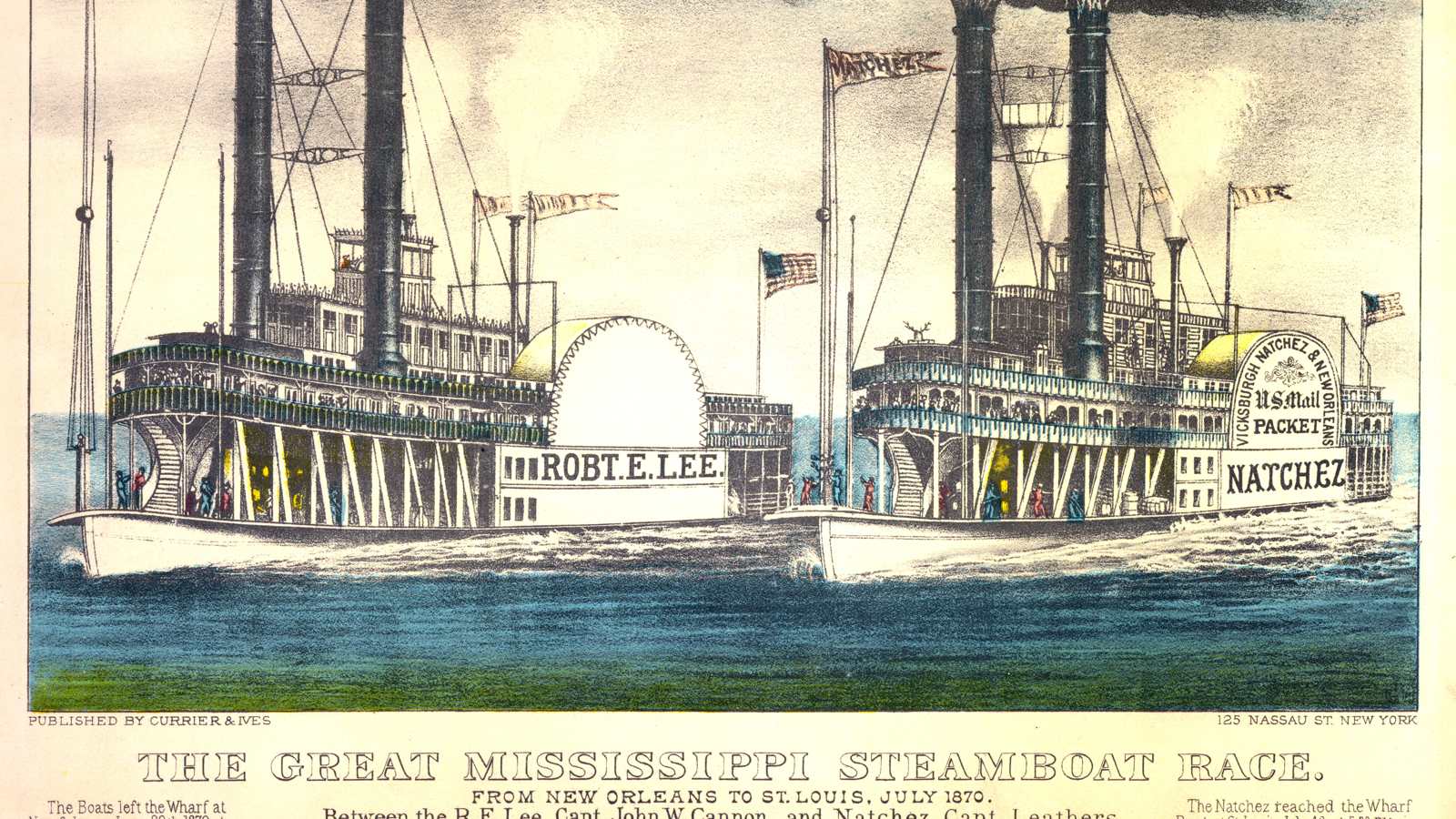
At mid-century the steamboat was America's freight system and theatre — the world Mark Twain, a licensed Mississippi pilot from 1859, chronicled in Life on the Mississippi. Packets raced whenever two met — speed was advertising — and it peaked on June 30, 1870, when Captain Cannon's Robert E. Lee left New Orleans against Captain Leathers's Natchez for St. Louis.
The Lee was stripped bare, carried no cargo and steamed through fog with a single stop; the Natchez ran loaded and tied up when the fog closed in. The Lee's time — 3 days, 18 hours and 14 minutes over some 1,210 miles — is still the benchmark. The Natchez, delayed by fog and repairs, finished about six hours later; her partisans argued for decades. Currier and Ives fixed the finish in memory; the Met's impression of their lithograph shows the two boats side by side.
Beneath the pageantry ran a grim ledger: boilers exploded often, and after disasters killed some 700 people in eight months, Congress passed the Steamboat Act of 1852: federal inspection, boiler testing, safety valves, licensed pilots and engineers. It could not prevent the worst of all: on April 27, 1865, the overloaded Sultana — certified for 376, carrying some 2,300, mostly just-released Union prisoners — blew her patched boilers above Memphis. The dead were never counted exactly: official reports said over 1,500, tradition says about 1,800, and a modern name-by-name count finds 1,169 deaths among 2,137 aboard. On any count it remains America's deadliest maritime disaster.
War, Railroads and the Long Decline
The Civil War turned the fleet into a navy — Union ironclads fought down the Mississippi to Vicksburg — and peace delivered the deeper blow. Railroads took the passengers and valuable freight in the 1870s–80s: faster than any packet, indifferent to river levels, still running when rivers froze. Packets thinned to local trades and excursions; steam lasted longest in towing, sternwheel towboats pushing bulk barges into the twentieth century until diesel took over in the 1920s–30s.
The Steamboats Still Standing
The Belle of Louisville — built at Pittsburgh in 1914 as the Idlewild — is the oldest operating Mississippi River-style steamboat in the world, a National Historic Landmark still cruising. The Delta Queen (1927), whose exemption let her carry overnight passengers until 2008, waits dockside for restoration. New Orleans' steamboat Natchez (1975) still runs daily cruises under steam. The American Queen of 1995 — 418 feet, the largest steamboat ever built, her engines recycled from a retired Army Corps dredge — proved the century could still build one.
Today's towboats descend from Shreve's shallow hull, and steam is the hinge between two of our other histories: it ended the working world of the history of sailboats, and its small successor fills the history of outboard motors. Start with the boats for sale in every size and budget; a boat bought across the country can come home through the transportation providers.
History of Steamboats Myths Worth Retiring
"Robert Fulton invented the steamboat." Fulton commercialized it. Working steamboats ran in France (1783), America (1787–90) and Scotland (1802) before 1807; Fulton added the route, the capital and the monopoly. "The Clermont was her name." She was the North River Steamboat; Clermont was Livingston's estate, and the name stuck later. "The Natchez won the great race." The Robert E. Lee won it in 3 days, 18 hours and 14 minutes; Natchez partisans argued for decades that deducting the fog lay-up made her faster — a different race than the one run. "Steamboats disappeared in the 1800s." Steam towboats worked into the 1900s, the Delta Queen carried overnight passengers until 2008, and the Belle of Louisville (1914) still steams.
History of Steamboats FAQs
Who invented the steamboat?
No one person: Jouffroy d'Abbans demonstrated one in 1783, Fitch ran a scheduled service in 1790, and Symington's Charlotte Dundas towed in 1802. Fulton's 1807 boat first succeeded as a business — why his name owns the story.
Why did steamboats matter so much in American history?
They reversed the rivers: upstream freight that took keelboats three months or more took Shreve's Washington 25 days in 1817. Cheap two-way transport tied the interior to the Atlantic economy and fed the cotton trade.
Were steamboats really as dangerous as legend says?
Yes — explosions, fires, collisions and snags killed thousands before the Steamboat Act of 1852 imposed federal inspection and licensing; it still came too late to prevent the Sultana disaster of 1865.
Can you still ride a real steamboat today?
Yes: the Belle of Louisville (1914) still runs excursions, and the steamboat Natchez cruises daily from New Orleans under real steam. The Delta Queen (1927) awaits restoration; the 1995 American Queen is the largest ever built.
Bottom line: the history of steamboats runs from a French marquis's experiment to a 418-foot river queen in one long century, and it never entirely ended. Browse the boats at BoatDealsDirect.com — every towboat and cruiser listed works the water steamboats opened.