Center Console Buying Guide: Sizes, Power & Checks
One hull layout covers more of the market than any other, and that is exactly the problem this center console buying guide exists to solve. The same format is sold as a 17-foot flats skiff, a 25-foot family hybrid and a 40-foot offshore machine with three engines — boats that share a helm position and almost nothing else. The decisions that separate them are the hull job, the size, the power count, the layout and the top, and each is cheaper to get right on paper than on water. Maker rankings live in our best center console boat brands round-up and the format's origins in our history of center consoles; this guide owns the purchase itself.
What Is a Center Console — and Who It's For
A center console puts the helm on a console in the middle of an open deck, so the crew can walk the boat's full perimeter. That layout is why anglers fight fish from any rail and why the format took over saltwater fishing. The trade is shelter: no cabin and usually no enclosed helm, so weather protection is a T-top, curtains and foul-weather gear rather than a door.
The type suits buyers who fish first or run open water to sandbars, reefs and islands, and who would rather hose down a self-draining deck than detail a cockpit. It is the wrong tool for overnighting, cold-climate shoulder seasons, and crews who expect lounge seating — a family-first layout exists (below), but a center console never seats like a bowrider.
Bay Boats, Hybrids and Offshore Center Consoles: The Three Hull Jobs
Bay boats: shallow water, short runs
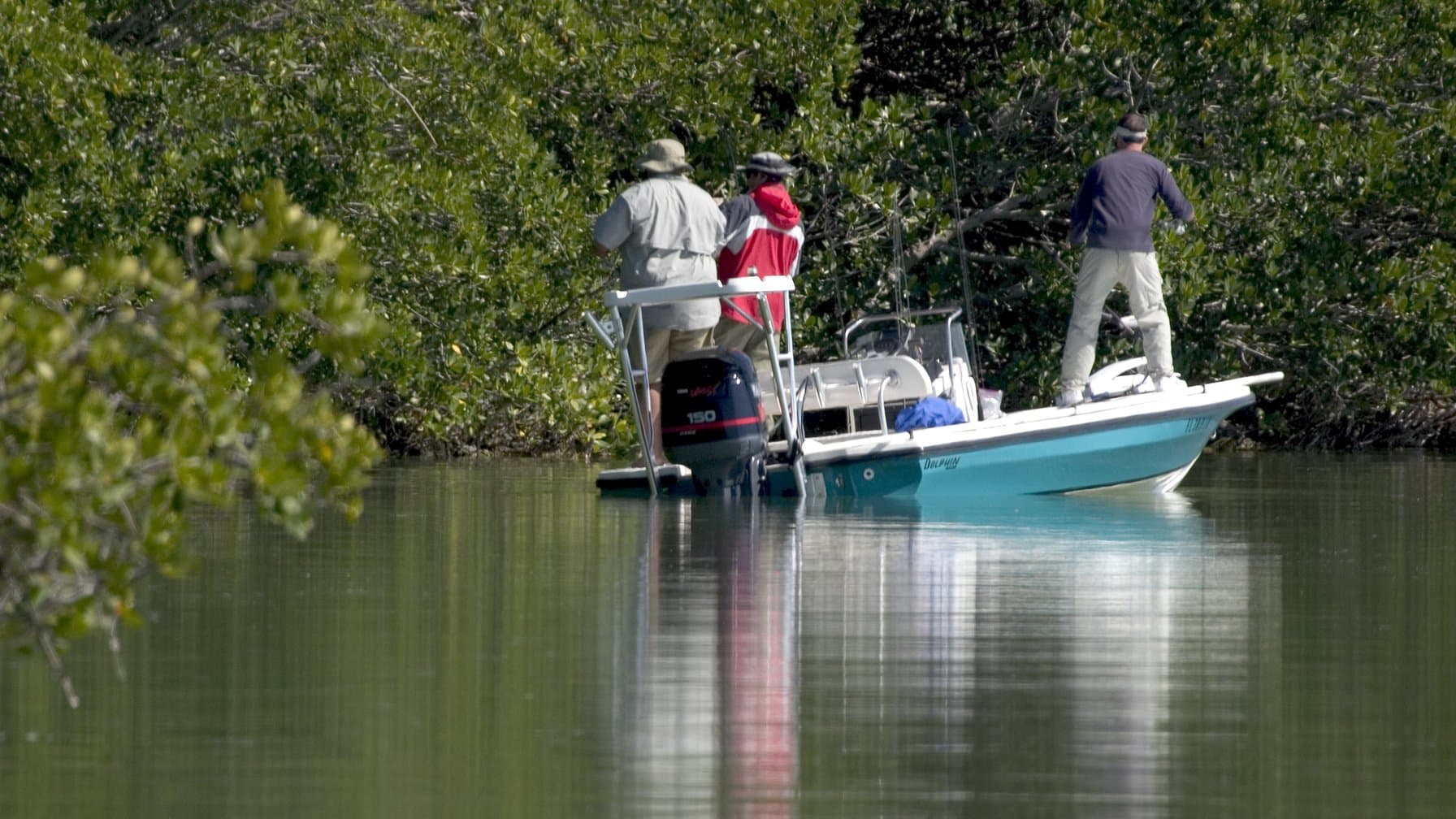
Bay boats carry low freeboard, modest deadrise and shallow draft for flats, bays and inshore work, usually with a casting deck forward and a single outboard. Scout's smallest center console shows the shape: its 175 Sportfish is 17 feet with room for six, built to fish shallow lake beds, flats and river channels. Boston Whaler's Dauntless family stretches the bay formula to 22–28 feet. A bay boat asked to run 20 miles offshore in chop will do it slowly and wetly; that is a hull mismatch, not a defect.
Hybrids: the crossover middle
Hybrid hulls add freeboard, a sharper entry and an offshore-capable bow to the bay layout, at the cost of deeper draft. Scout positions its 251 XS exactly there — a 25-footer for both inshore and offshore fishing, with a T-top glass-enclosure helm. Hybrids are the honest answer for mixed use: skinny water some weekends, nearshore reefs on calm days. They are also where family layouts concentrate — forward seating, a head inside the console, ski tow points — because crossover buyers fish and entertain with the same hull.
Offshore center consoles: deep-V and distance
True offshore boats carry a deep-V (typically 20-plus degrees of deadrise), high freeboard, big fuel capacity and usually more than one engine. Boston Whaler's Outrage line, 23–42 feet, is the segment's template. These boats are heavier, thirstier and costlier to run, and they earn it where a bay boat cannot go: open ocean. Fishing-first offshore layouts strip the bow seating for a flat casting deck; family-first versions add loungers and a sun pad — decide which before you shop: the same model name ships both ways.
Center Console Sizes Compared
| Length class | Typical crew | Water it suits | Typical power |
|---|---|---|---|
| 17–21 ft | 6–8 | Bays, flats, lakes, nearshore | Single 90–200 hp |
| 22–26 ft | 8–10 | Bays to nearshore reefs; hybrid hulls | Single 250–300 hp or twin 150s |
| 27–33 ft | 10–12 | Offshore runs in open water | Twin 250–300 hp |
| 34 ft and up | 12+ | Long-range offshore | Triples or quads |
The table is a starting frame, not a specification — check the maker's plate and spec sheet for any individual boat. Two capacity rules matter at the small end. Federal rules require monohull boats under 20 feet to carry a capacity plate stating persons, weight and maximum horsepower; above 20 feet there is no federal plate, and NMMA-certified boats are "yacht certified", with capacity set by the builder's design. Crew figures for larger boats are seating counts, not legal limits.
T-top, hardtop or bimini: the shade decision
A bimini top is the budget answer — canvas on a folding frame, fine at anchor, flappy at speed. A T-top bolts a frame and lid to the console: permanent shade, rod holders and mounts for lights and antennas, at the price of bridge-clearance and trailer-height checks. A fiberglass hardtop, standard on larger offshore boats, integrates lights, speakers, outriggers and an electronics box. Whichever top a used boat wears, its mounts are structural — they get their own check below.
Single, Twin or More: Choosing Outboard Power
A single engine is the cheapest to buy, service and feed, and modern four-strokes are reliable enough that most boats under 26 feet run one. Its weakness is arithmetic: one failure ends the day. Twins answer that — redundancy that gets you home on one engine, better dock manners, and cruise speeds a single cannot hold — at double the service items and a five-figure premium per added engine. Triples and quads belong to 34-foot-plus boats chasing speed and range; Scout's line runs to a 53-foot flagship on quads with 875 gallons of fuel.
The running-cost side outweighs the purchase side: every added engine adds its own oil, filters, impellers, lower-unit service and eventual repower. Our cost of owning a boat breakdown works through what each engine adds per year — read it before deciding the second motor is "only" a payment difference.
Center Console Prices and the Total Budget
Anchor the new market at the small end: Boston Whaler's own configurator prices a 170 Montauk at $52,948 as configured — 17'4", max 115 hp, seven-person capacity, 25-gallon tank. From there the curve steepens fast: equipped 22–26-foot hybrids commonly cross six figures, 27–33-foot offshore twins sit deep in six figures, and 34-foot-plus flagships reach seven. The boats under $200,000 browse holds most of the new-entry and clean used market; the boats under $100,000 browse is where used 17–25-footers concentrate.
Used supply is deep at every size, and condition spreads wider than asking prices suggest — two same-year boats can differ by a repower. Budget past the hull: trailer or slip, electronics, safety gear, tax, registration, first service. Get a figure from finance providers early if borrowing, and remember: the payment is the smallest number in offshore boating.
What to Check on a Used Center Console
The shared used-boat spine — paperwork, sea trial, compression and service records — is covered in our used boat inspection checklist. A center console adds its own list. Work the fuel system first: ethanol-aged hoses, sender access, tank material and fuel smell in the bilge, because a buried tank replacement can cost more than the engine. Check T-top and leaning-post mounts for cracked welds, corrosion at the feet and movement when you haul on the frame. Trace wiring for chafe and amateur splices, and sound stringers and transom for soft spots.
Engine hours mean little without records: a 600-hour motor with annual dealer invoices beats a 250-hour motor with none. The BoatUS Boat Buyers Guide sets out what a condition-and-value survey covers; BoatUS Magazine puts the cost at about $20–$22 per foot and advises hiring your own surveyor, never the seller's. On any offshore-class boat, treat that fee as non-negotiable.
Center Console Buying Guide Mistakes Buyers Repeat
Buying the offshore hull for inshore water — a heavy deep-V that drafts too much for the flats you fish. Buying the bay boat for offshore ambitions, the mirror error, discovered in the first inlet crossing. Counting engines as pure upgrade and never pricing the doubled service schedule. Judging capacity by seating instead of fuel range and weather judgment. And falling for the electronics package while skipping the checks that decide what the boat costs in year two.
How to Shop Center Console Listings and Close the Deal
Start in the boat listings and filter by length class and budget using the table above — work the marketplace's deepest segment in passes: hull job first, then size, then power count. Read each listing against this guide's checks: engine hours with records, top type and mount condition in the photos, fuel-tank access, and whether the layout is the fishing or family version. Shortlist makers using the center console brands round-up, then sea-trial finalists in the water you intend to run — a hybrid that feels planted in the bay tells you nothing about the inlet. The closing sequence — offer, deposit, survey contingency, title and registration — follows the boat buying guide.
Center Console Buying Guide FAQs
What size center console is best for offshore fishing?
For regular open-ocean runs, 27–33 feet with a deep-V hull and twins is the working standard: enough length to span chop, enough power to run home on one engine. Smaller hybrids handle nearshore work on picked days; flagships buy speed and range, not more safety.
Is a single outboard enough, or do I need twins?
A single is enough for bays, lakes and nearshore use, and it is the cheapest configuration to own by a wide margin. Twins earn their cost when a dead engine far offshore is a safety problem rather than an inconvenience — a question about where you run, not how fast you want to go.
How much does a new center console cost?
Prices start at about $53,000 configured for a premium 17-footer and rise steeply with length and engine count: six figures is normal for an equipped 22–26-foot hybrid, and the largest models reach seven figures. Most used buying happens under $200,000.
Bay boat or offshore hull — how do I choose?
Choose by the roughest water you will run regularly, not the calmest. If your fishing is flats, bays and inshore, a bay boat's shallow draft serves you every trip; if you cross inlets and run offshore reefs, buy the deep-V and accept the draft. Hybrids split the difference for mixed use.
Bottom line: this center console buying guide reduces to matching three things — hull job to your water, engine count to your distance from home, and checks to the type's weak points. Get those right and the Boat Deals Direct listings hold a deep bench of candidates at every size.